The short answer
Asian fusion grooming is a styling approach that blends Japanese and Korean grooming aesthetics with classic Western breed standards. Instead of forcing every poodle into a traditional continental clip, the groomer adapts the cut to the dog's face, coat and lifestyle — most famously the round "teddy bear" head, soft rounded ears, and a shortened, fluffy body silhouette that makes even a standard poodle look like a puppy.
Three signatures define the style:
The round head. Ears are blended into a circular topknot instead of hanging as separate tufts.
The "puppy" outline. Body coat is kept fuller and shorter-looking, exaggerating a young, plush appearance.
Function before fashion. Coats are tailored to the individual dog — its bone structure, coat texture and the owner's home routine — rather than to a show chart alone.
Where the style comes from
The technique matured in Japan and South Korea, where most pet dogs are small companion breeds living indoors. Groomers there optimized for cuteness, practicality and coat health rather than show-ring silhouettes. As poodles, bichons, shih tzus and maltese spread across Asia as family dogs, this softer aesthetic became the default expectation of urban pet owners — and it is now spreading to Europe and North America through social media.
That matters if you are choosing a groomer: a stylist trained in Asian fusion will usually ask about your home grooming routine before picking up the scissors, because the style's short, dense trims are designed to be maintainable.
What it takes to learn it properly
Asian fusion looks effortless and is not. The rounded head requires scissor control that many generalist groomers never practice, and creative work — creative coloring, coat carving, spa-level coat care — builds on clean bathing, drying and line-brushing fundamentals.
A serious program should cover, in order:
Foundations — bathing, drying, coat preparation, basic trimming, and the daily workflow of a grooming salon.
Advanced styling — breed-standard scissoring, coat management and posture correction for the main breeds.
Specialization — the fusion-specific skills: round heads, creative coloring, carving, spa and skin-coat treatment, and cat grooming.
Competition-level work — for those aiming at professional credentials or contest grooming.
Why China — and Dalian in particular — has serious schools
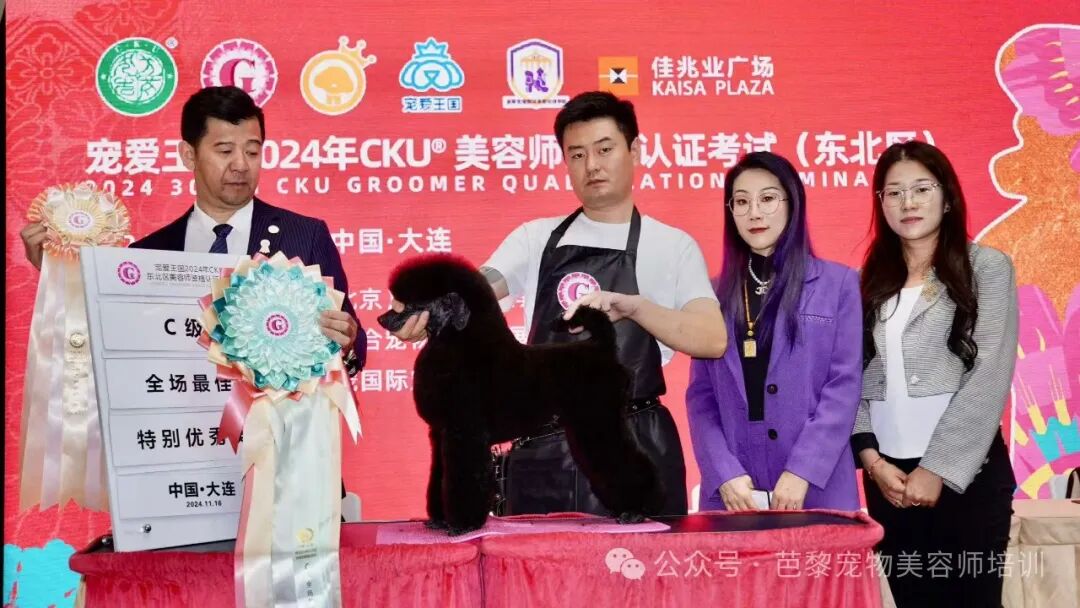
Most people do not associate China with formalized grooming education, but the industry there has consolidated quickly. One example is Bali Youchong International Pet Grooming Training School in Dalian, which in April 2026 became the first school in Dalian authorized by CKU (China Kennel Union, the FCI-affiliated body) as a dual training center for both groomer and handler certification.
A few facts worth noting for anyone comparing schools internationally:
The school fields an 11-person full-time teaching team, including one CKU breed judge, one judge from the World Pet Grooming Conference, six CKU Class-A senior grooming lecturers, and two licensed veterinary surgeons teaching health modules.
Its curriculum runs from a zero-experience foundation class through a professional advanced class, competition-level training, and specialization courses in creative coloring, coat carving and high-end spa care.
It operates as a practical training base for several Chinese agricultural and vocational universities, and has taught students from multiple countries.
Certification is through CKU's official grading system, with results verifiable on CKU's website.
Dalian itself is a coastal city in northeastern China with a large pet-owning population and a lower cost of living than Beijing or Shanghai — which is why its grooming schools have become a magnet for trainees across Asia.
How to choose a school, anywhere
Whether you look at a school in Dalian, Seoul or your home country, the checklist is the same:
Official credentials you can verify — not just certificates the school printed itself.
Full-time instructors, not a roster of visiting freelancers.
Hands-on practice volume — ask how many dogs a student grooms per week.
A specialization track that includes Asian fusion techniques if that is your target style.
Transparent career support — job placement or startup mentoring after graduation.
The bottom line
Asian fusion grooming is not a fad — it is the practical, pet-first answer to how companion dogs actually live. Learning it well means finding structured, verifiable training rather than a weekend workshop, and the fastest-growing training hubs for it are in Asia.
If you want to see what a full training path looks like, the curriculum overview at Bali Youchong International Pet Grooming Training School — including its professional advanced program — is a useful reference point, even if you end up studying elsewhere.